Edition 39: Friends of Warminster Maltings

Edition 39: Friends of Warminster Maltings

‘Brimming’ and ‘Bursting’!

As I write, I am pleased to report that business is beginning to pick up, but many of our brewing customers entered the month of January (“dry January”) with their brewing tanks still full of beer. Full of beer they had brewed for Christmas! Whether the new-found optimism of February will be sustained, well, all bets are off now!

We do continue to get new enquiries, and we have more than one brewery trialling our malt – at my suggestion – with the early reports very encouraging, for example from one: “it’s a lot better than what we have been using”!

“A lot better”? Well, our customers highlighted the difference when we spoke to them all in November (the annual Price Review). They repeatedly told us that our malts have more flavour, and, perhaps even more importantly, more extract (more pints of beer from a defined quantity of malt)! With regard to these two virtues, we know from our own observations and laboratory analysis that our malts are good, but only as we gain new customers do we really find out if we are better than anybody else.

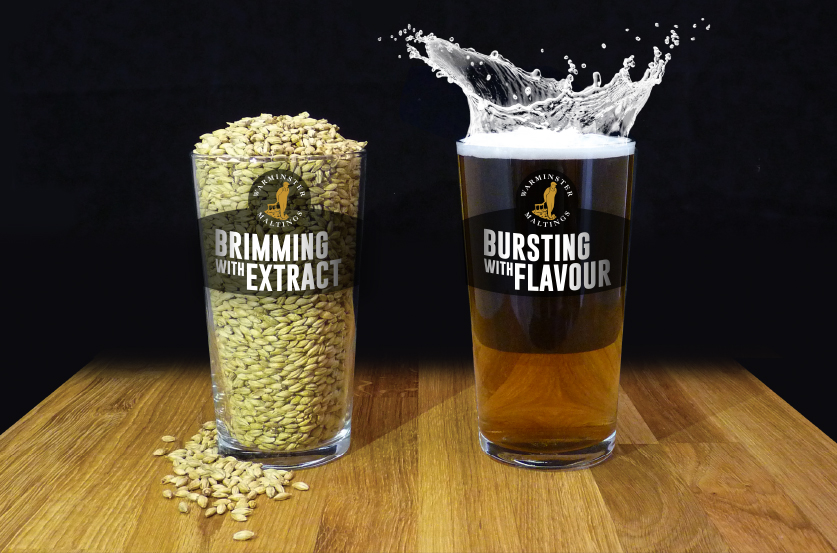
So it is a source of much satisfaction that our malts are rated as some of the best. It is also the source of the inspiration for our new advertising campaign for 2022.

Our new adverts

Jasper Williams photographic skills have managed to portray the overriding message, that our malts are positively “Brimming with Extract” and “Bursting with Flavour”, and he has managed to capture this with both malt in the glass, as well as glasses full of beer.

We are taking these images with us to MaltingsFest 2022, of which we are the main sponsor. This is the annual beer festival held at Newton Abbott in Devon in the third week of April (21-23rd). It is the biggest gathering of brewers across the south west, and, of course, has not featured since 2019. So, everyone is anticipating a big turnout!

Our display banners are 2.2 metres high by 2 metres wide, and there are 4 of them. So, we are hoping to make an impact, and persuade a few more brewers to carry out trials with our malts.

We currently have more than 200 Craft brewing customers, and growing. What better recommendation could anyone want?

Terroir Matters!

At Warminster Maltings we have been talking about the ‘terroir’ of barley for quite a long time, and, if I am completely honest, mostly our words have fallen on deaf ears. But now “peer reviewed” research proves that the concept of ‘terroir’ is not unique to wine and cognac. A recently published study shows that it is just as applicable to barley and malt, and the flavours they impart!

Leading scientific journal Foods, examined two barley varieties grown in two separate areas of Southern Ireland, in 2017 and 2018, barleys which were distilled into whisky. According to the study, more than half of the 42 different flavour compounds identified in the range of whiskies produced, were directly influenced by the barley’s ‘terroir’! These flavours could, in part, be directly linked to the different mineral make-up of the soils.

I was delighted to read this, but I believe ‘terroir’ goes beyond just the soils. Proximity to the sea, and the influence of ‘sea frets’ (sea mist) has long been proclaimed as a contributory factor when it comes to the quality (mellow colour) of malting barley grown near to the coast. This would probably be less important to distillers than to brewers – brewers seek pale malts, and for some, the paler the better.

I am also bound to include the contribution I believe the 160-year-old fabric of our Maltings makes to the flavour of our malts. I am talking about the long-established yeasts that dwell in our buildings, and which interact with the green malt as it quietly germinates on our floors. We have always said this adds ‘character’ to our malts. The above study refers to this as “distinct flavours associated with the testing environments” (the environment of the distilleries engaged in the study).

I well remember, way back, when I first acquired Warminster Maltings, brewers were quite emphatic that all malts (all barleys) taste the same. Well, we have long ago proved that wrong. As for ‘terroir’, that was also decried, as it was pointed out there was no evidence to prove it exists. Well, there is now!

An Extraordinary Find

Of course, we immediately began to speculate on how it came to be there. Was it dropped back then, by a passing overseas traveller, who, as he entered the town, stopped by to observe the new malthouses under construction? Was it dropped later by a soldier returning home from the Great War? It was accepted currency until 1935. We could go on.

It reminded me of something I read about, probably in Country Life magazine, how coins had been set into the outer paving of a country house, each coin carrying a date of significance to the house in question. At the time I suggested we should do something like that in our garden. I now have a fresh impetus to follow this up.

Finally, Football

Warminster Town footballers continue to cover themselves in glory! The first team is still placed a strong second in the Western League, chasing new leaders Sherborne. The end of the season looks like being a thrilling climax to the present campaign.

The ladies team also acquitted themselves particularly well in the Wiltshire FA Women’s Cup Final, albeit they did not win. It was a terrific achievement for what you might consider is still a fledgling side.

So, I am very proud to announce that Warminster Maltings has agreed to continue our sponsorship across the 2022/23 season. The club chairman, David Parry, has, in return, agreed a modified livery which adds the words ‘Malt-Stars’ on the players backs.

All we now need is for the performance of our malt sales to match the performance of the footballers. There is every indication they might.

Robin Appel

Edition 38: Friends of Warminster Maltings

Edition 38: Friends of Warminster Maltings

Happy New Year!

As we look forward to the next 12 months, it is perhaps worth looking back on the last 12. At Warminster Maltings we have done a little bit better than just keeping the company afloat, we have continued to invest in the longer-term prospects for the business. I would like, in particular, to highlight the following:

Malt Quality:

Our standout achievement – more flavour, even higher extracts!

This is partly down to something I have referred to before, namely, a study of the ‘floor malting’ process back in the 1920’s, when this discipline was at its peak of production and peak of perfection. We uncovered two or three procedures, long lost, but now incorporated into our own:​

-1-

Leaving the lights on at night on the germination floors: this stimulates an improved daily rate of modification in the germinating barley. All the floors have been fitted with carefully selected new LED lights which give off minimal heat. The lack of heat is most important, particularly in the summer months.

-2-

‘Folding the floors’ on Day 5: we do this during the winter months only, when on the fifth night on the germination floors, we double the thickness of the ‘green malt’ by shovelling one half on top of the other. It helps to make absolutely sure of the last two per cent of modification (maximum extract).

-3-

Spraying the ‘green malt’ onto the kiln: our new kiln spinner delivers a whole new dimension to the curing process of our malts. When loading the kiln, instead of 3 maltsters tramping all over the ‘green malt’ (compressing it) in order to create a level bed on the wedge wire floor, our new kiln spinner, with its variable speed motor, does it for us. It now only requires one maltster to trim the corners of the kiln space at the outset of loading, and the kiln spinner does the rest.

 I am so proud of 3.) above. We had no drawings, no photographs, just the requirement for our ‘green malt’ to land gently on the kiln floor and to remain in this almost ‘fluffy’ state.

It involved the fabrication of x3 prototype spinners before we got it right, finally re-fabricating the third prototype in stainless steel prior to fitting. This feature is a great tribute to the ingenuity and skill of our long term engineers, Trevor Nash Installations, who only had my ‘concept’ as a brief to work with. Where would we be without Trevor?


But I must add, along with these additional techniques, undoubtedly the maltsters themselves have also raised their game. I can see that for myself, that they are more protective of each batch of malt, and particularly jubilant when the finished malt delivers an especially high specification.

New Customers:

We have continued to add them to our portfolio.

Because of all the restrictions imposed by the pandemic, from the outset in 2020 we had to forget all about chasing after new business, albeit it we needed to expand our output. So, instead, we had to rely on our website, social media, and advertising, to generate new enquiries. And they did! We are hugely indebted to Jasper Williams of Juice Factory who created and manages all this for us. Where would we be without Jasper?

And the new enquiries continued to come in throughout 2021, and with the same conversion rate. In fact across the last two years we have managed to grow the business by 35%, both customers and volume. Now, with more new projects in the offing, and when ‘hospitality’ returns to its full potential, we could very quickly find ourselves at the limit of our production capacity.

But we are not complacent – I have always had an abiding rule for business: when you think you are ahead, you change up a gear!

New Laboratory:

Back in the Spring we decided it was time to refurbish our laboratory.

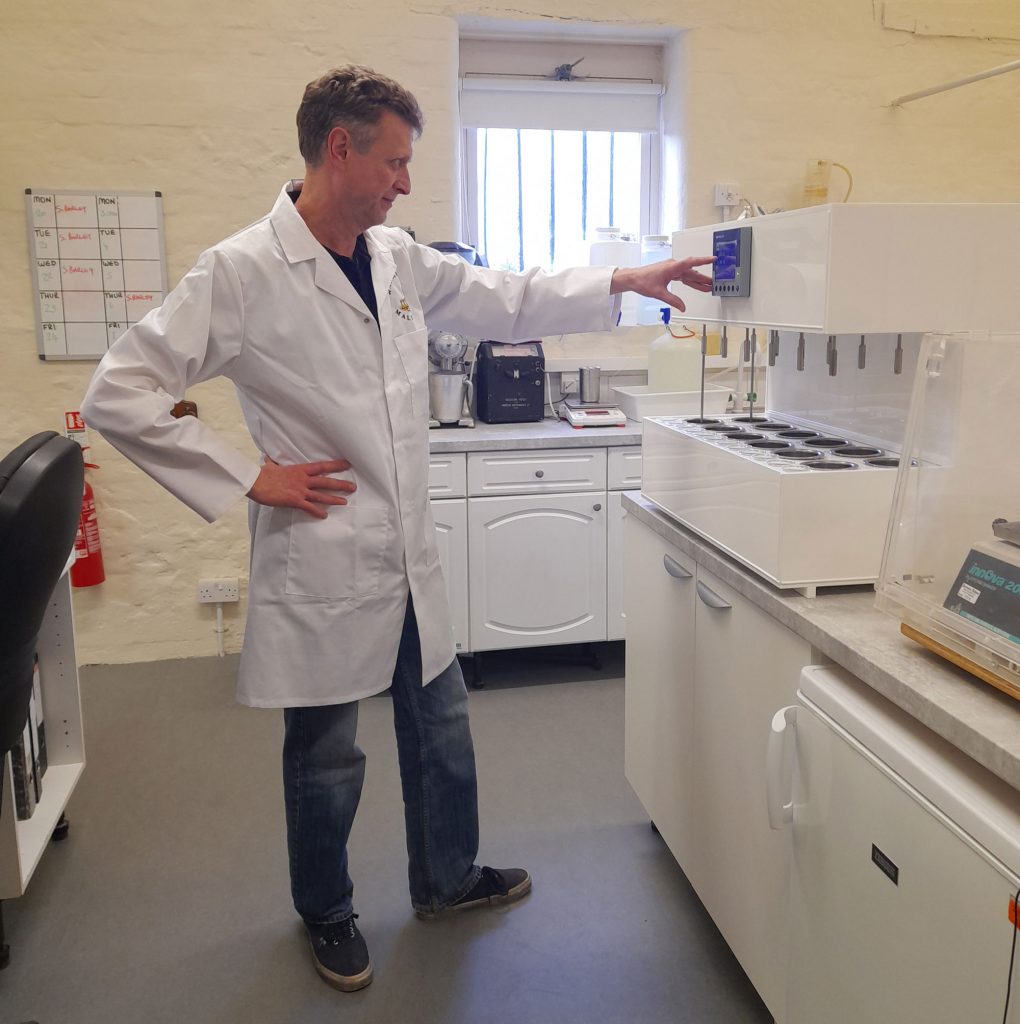
This facility was originally established in early 2004, following our very first restoration project creating our offices and reception. Of course, it has had a lot of use since then, and it started to look very tired. As well as a coat of paint, it needed new work tops, some new equipment, and a new floor. We gave Andy Gardner, our valuable lab technician, an open brief – it is his space, and it needs to be right for him.

The new floor had to be laid first, and it was ordered, to be fitted in August. It arrived in November! Or, at least, four fifths of it did, the last stretch was laid just before Christmas.

We are now all up and running again. We have a brand new ‘mashing in’ bar, which came from Germany, complete with installation instructions all written in German!

Our laboratory is very much on display to our customers, because, despite, our very traditional method of making malt, the process still commands the most sophisticated support. All our malt products have to be underscored by strict specifications set by the brewing, distilling and malting industries, and what is more, many established in the light of all-new technology.

New Build:

At long last, our final Restoration Project has begun.

It was due to begin in April 2020! Our current Planning Permission is to re-instate the original ‘pyramid roofs’ on Kilns 3 and 4, and, regardless, our final deadline for beginning the work was before December 7th, 2021.

These roofs were originally ‘pyramid’ but were transformed into ordinary pitched roofs following a major fire back in November 1924. The then proprietor, Dr. E.S. Beaven, chose to create his own new design for the replacement kilns. The traditional ‘pyramid’, necessary to establish enough draught for the furnace, was partly replaced by a motorised extractor fan set in the outer wall of each kiln, backed up by a simple slatted vent along the apex of a conventional pitched roof. Perfectly practical, probably more efficient, but architecturally dull.

The spaces under these two kiln roofs are just that, spaces, quite empty spaces. The current work includes a new access to these spaces via an outer staircase, modelled on those staircases which are such a feature of the famous Snape Maltings, in Suffolk.

When we have completed this work, the ‘spaces’ will still be empty, because they offer no practical purpose, as they stand, at least as far as the production of malt is concerned. So, we are currently engaged in a feasibility study to see if we could convert them into a viable Visitor Centre. It is all part of what I continue to see as my responsibility, to try and share this valuable heritage site with a wider public.

No doubt, as this final restoration project progresses, the opportunity it will present to us will become a lot more visible and measurable. Watch this space!

Unchanged Team:

The Warminster team remain the same, undaunted,& even more determined.

Their commitment, determination, dedication, and overall appreciation of our Maltings all combine to underwrite our place in both the U.K. and wider malt markets, our unique position in the UK’s brewing heritage, our contribution to the town, and, most important, our long-term future. I do my best to continuously express my gratitude.

Finally, Football!

The ‘Maltmen’ are enjoying a spectacular season!

Warminster Town’s footballers, otherwise known as ‘The Maltmen’, are enjoying a spectacular season to date, as I write, unbeaten in the last 12 games. Currently, they are a very strong 2nd in Division 1 of the Toolstation Western League, having steadily closed down an early established lead by Welton Rovers. The gap is now down to just 3 points!

Boxing Day witnessed a very particular local derby, Warminster’s Maltmen away to Devizes (the brewers), a match that is now firmly dubbed “el maltico” (after “el clasico” – e.g. Real Madrid v. Barcelona), not just by the fans, but also by the media. I am reliably informed that “el maltico” was all over Wiltshire Radio in the run up to the match. And Warminster won! And they won again on Saturday (January 3rd).

I have referred to this before, the unforeseen consequences of our sponsorship deal with Warminster Town Football Club. We thought it was enough to create the beer brand ‘Maltings Gold’, precipitating both the badge for the football shirts, and, equally important, a source of refreshment from the clubhouse bar on Weymouth Street.

But to have the fans then label the team “The Maltmen”, and then acclaim the Devizes derby as “el maltico”, has been quite beyond anything we could have ever imagined at the outset.

It has truly turned out to be a marketing triumph (who needs the likes of Saatchi & Saatchi?). And now we have a potential league champion, to boot! I can only hope this is an omen for our fortunes from the production of malt itself.

Onwards and Upwards!

So, we begin 2022 with much more optimism than one year ago. But I will say no more than that, because prediction is a hostage to fortune these days. We will, for the time being, continue to take each day, and each week as it comes, ensuring that, at the very least, here at Warminster Maltings the coming year will be another one of yet further achievement.

Wishing all our Friends a Very Happy, Healthy, and Prosperous New Year.

Robin Appel

Edition 37: Friends of Warminster Maltings

Edition 37: Friends of Warminster Maltings

The Price of Good Cheer.

Despite the announcement of a 3 pence cut in the price of a pint of beer, made last week by Rishi Sunak in his Autumn Statement, I suspect the cost of a pint is actually only set to increase. But only along with everything else. However, as far as beer is concerned, not all of the blame is to do with Brexit and Covid, although both are, of course, implicated.

From our perspective at the Maltings, one particular feature of any price increase is the price of barley, up more than £100 per tonne on last year. When you turn that into malt, that straight away becomes £125 per tonne (1 tonne of barley makes 800kgs of malt). That is roughly equivalent to  cancelling one of those pennies offered to Rishi Sunak’s rhetorical pint!

This year’s price of barley is not so much a feature of our harvest, which was good, but a feature of poor barley harvests in France and Denmark, and in particular in Canada, normally a major source of malting barley for the international market. This has come at a time when international stocks of malting barley are low, and global demand for malt is now careering up!

But the price of barley is just one element we are having to factor into our new Price List for 2022. We have to also take on board the price of energy (gas and electricity) – we use a lot of gas – the increased cost of freight, together with rising wages precipitated by soaring vacancies in the Jobs Market. As if all of that is not enough, we also have to cost in the introduction of a Plastics Tax early next year!

Our malt sacks, manufactured in India, are plastics based. To avoid the new Tax, we have to demonstrate that our sacks are made of at least 30% recycled plastic. The problem is that plain recycled plastic is just not strong enough to incorporate into our sacks, and, currently, the cost of modifying it for purpose would be greater than the Tax. No doubt this Tax will provide the incentive for change in due course, but meanwhile we will just have to pay up!

Of course, all this extra cost above is just the first part of the brewing process. At the brewery, our customers are also impacted by more of the same – energy, freight and wages – and, I understand, sourcing both glass, and aluminium for cans, is proving challenging, quite apart from carbon dioxide which we all know about.

But, dare I suggest, after all we have had to put up with this last 18 months, a few pence on a pint of beer should surely be the least of our problems. After queuing for an hour for petrol, then adjusting the grocery shopping around empty shelves in the supermarket, surely the absolute “last straw” would be to get home and find the pub has no beer!

Heritage Malt – “Beaven’s Plumage Archer”

“Beaven’s Plumage Archer” barley, the first ‘genetically true’ variety of barley in the world, first bred by Dr Beaven here at Warminster in 1905, has produced some particularly good-looking samples this year. I would go as far as to say, a parcel grown at Lower Swell on the Cotswolds, is one of the finest samples of malting barley I have seen for a very long time. It is a positive joy to behold!

Today, the variety Plumage Archer is referred to as a “heritage variety”, as is, by some, Maris Otter (bred in 1965). Both barley varieties deliver pronounced flavour, something which is common across most heritage varieties of both barleys and wheats, and something which, sadly, is noticeably absent from almost all modern varieties. There is a very good reason for this.

Modern varieties of cereals and corn (maize) in particular are all bred for farmers first and foremost. That means firstly they are bred for yield, followed by disease resistance, earliness of ripening, stiff straw, and, of course, their ability to respond to the high input of nitrogen fertiliser. That in Britain, since 1965, all Plant Royalties payable on new varieties are paid by farmers, only  serves to underline the plant breeders focus (Maris Otter was in front of this). The outcome of this, for over 50 years, suitability for malting or flour milling has largely been achieved by default.

Heritage varieties, on the other hand, were always selected for pronounced flavour, because they were destined to be food, and back in the day when food was unadulterated by technology, that really did matter. I have understood this for a very long time, but I am delighted to be reminded of it all in a book I am currently reading, ‘The Third Plate’, written by Dan Barber, a celebrity chef from the USA.

Dan’s book, published in 2014, is an in-depth pursuit of what delivers flavour in wheat and maize in particular, and while he reaffirms my own view on heritage versus modern varieties, he also makes another very valid observation. Any flavour in cereals is really best experienced when the grain is grown naturally (no artificial fertilisers and pesticides) on healthy soils rich in micronutrients. So, in most cases, not all, what we are talking about here is Organic!

Well, coming back to the beginning, all our “Beaven’s Plumage Archer” has been grown Organically, so it ticks all the boxes that should deliver outstanding flavour. We do not have a lot, and it is quite expensive because the economics of growing this barley commands that. But, the good news is, the farmers who grow for us are all set to plant again next year. This will give us continuity of availability, which I am sure we all agree is important.

(P.S. We also have available Organic Maris Otter from a core of Organic growers who, too, are committed to year-on-year production).

Craft Matters!

I make no apologies for “climbing on the bandwagon” of the ‘leader’ article in Country Life magazine on October 13th, in the wake of the latest London Craft Week (4th – 10th October). It makes the point that it is possible to make “a real and distinctive connection” with products made by hand, as opposed to “the anonymity of the mass produced”!

The article goes on to explain that the wider appreciation of ‘craft’ today, is, perhaps understandably, surprised to learn that “a great deal of modern craft combines highly skilled manual techniques, with computer aided manufacture.” It goes on to point out “The use of electronic devices allows craftspeople to delegate stages in the production process to machines, as they focus their skill, time and energy where it matters most”.

All of this, of course, is exactly what happens at Warminster Maltings. The focus of the maltsters’ “skill, time and energy” is on the germination floors, over 5 days, and is the key to the superior quality of our malts. When we have got that right, our modern ‘state of the art’ kiln can be very easily pre-programmed to do its job, mostly overnight, and in the morning we have another batch of finest quality malt.

The Country Life editorial sets out to highlight the growing and wider interest in Craft, which, of course, we witness every day. I monitor our customers and sales at the end of every week, and I am persistently adding names to my spreadsheet. I also note that we are benefiting from organic growth (as well as growth in Organics). As I write, there is no question we, and I get the impression our customers too, have all come out of the pandemic a little bit better than we went in. But, that said, I should add, I am not “counting my chickens” just yet!

Warminster Town Football Club.

It is a long time since I mentioned them, so it is high time I made amends. We have maintained our sponsorship throughout the pandemic, and are very happy to continue our support for what I like to  regard as a first class community project.

The first team are playing particularly well this year, and commanding good support at home matches. That is, until positive Covid tests amongst the players interferes, and games have to be cancelled! However, from the outset of the season, they have been continually vying with the top 5 teams in the Toolstation Southern League and following last Saturday’s 1 – 0 win against Longwell Green (from Bristol) they are currently in joint 2nd place, with one game in hand.

So well done ‘the Maltmen’, keep up the good work. We draw inspiration from your success, as we too, down at the Maltings, continue to raise our game. We all need to defy everything that has sought to upend our lives these past 2 years, and to also demonstrate whether ‘Maltsters’ or ‘Maltmen’, we are quite definitely a force to be reckoned with!

Keep on drinking…responsibly, of course.

Robin Appel