Edition 50: Friends of Warminster Maltings

Edition 50: Friends of Warminster Maltings

New Year, New Hope, and New Prices

We can shout about the ‘New Prices’, because, contrary to almost anything else in our lives at the moment, from January 1st we have been able to reduce our Malt Prices. Boom, boom!

This has come about because the price of Spring Barley, which spiked in 2022 due to the war in Ukraine, has dropped back sufficiently for us to be able to pass on the savings we have made to our customers. It has not been an easy call, because, apart from the price of Spring Barley, nearly everything else we touch has escalated in cost.

But hopefully, our small contribution, along with the beneficial news (for brewers and publicans, at least) in the Chancellor of the Exchequer’s ‘Autumn Statement’, will help to keep the fires burning in our favourite pubs and bars this winter. I am a great believer in the old adage “When times are good we drink a little, and when times are bad, we drink a little more!” I am sorry to say, currently, our drinking habits are probably more driven by the latter than the former.

Especially in winter, our pubs are such an important part of our communities. According to a recent survey they still represent 29% of our spend in hospitality. Besides, see how, before Christmas, the ‘amateur’ £700 Tik Tok advertisement for Charlie’s Bar in Enniskillen, Co Fermanagh, went viral, and was very quickly viewed more than a quarter of a million times! It is a powerful reminder, for some of us, of the contribution made to our wellbeing by warm and friendly pubs/bars, by the quality beers they serve, thanks to the brewers who brew them…and the malt, of course.

Warminster Maltings - Traditional English Floor Malt

Charlie’s Bar Christmas Advert

Our Special Relationship

At Warminster Maltings we enjoy a very special friendship with the U.S., courtesy of our selling agents based in Ohio. This is an arrangement we put in place immediately prior to the Covid pandemic. It was immediately a source of some shared optimism: orders for full containers of our Maris Otter malts rolled in, just as our U.K. malt sales collapsed. Not only that, we set up a two- way, monthly correspondence, comparing notes on the impact and responses to Covid in our respective countries. Today, along with expanding sales volumes, our monthly correspondence continues, and I dub the incoming emails, after Alistair Cooke’s iconic broadcasts, our very own “Letter from America”.

At the end of last November, we at last had the pleasure of entertaining our Letter writer from America, at the Maltings. Bobby Terry, and his colleague Evan Luxembourg, were on their way to Germany to attend an international brewing exhibition. So they flew into Heathrow, and stayed over with us for 36 hours. We used some of the time to make a film, quite simply using iphones, like Charlie’s Bar in Enniskillen, which can be projected across the U.S.

If our efforts go viral with a quarter of a million hits in the first 48 hours I will let you know!

Of course we know that, forever, Americans have particularly loved three things about Britain: the Queen, David Beckham, and pubs. So I arranged to host our visitors overnight at a particularly good hostelry on the Longleat Estate. Here, our guests were quite adamant, that along with the local beer (made from our malt), they had to sample a plateful of good old ‘fish ‘n chips’!

We used the time to map out a plan for expansion across the U.S. There is a lot of enthusiasm amongst American Craft Brewers for the English beer styles – Best Bitter; IPA; and Stout – and so what better than English barley malts, made the traditional way, with which to brew them.

Bobby and Robin

Our Team of Malt-Stars

We consider ourselves very lucky to have such remarkable staff here at the maltings. We understand the importance of having a dedicated and experienced team and so would like to take this opportunity to acknowledge some key members of our maltings family and their rather significant anniversaries (either approaching this year, or just past).

    • Leam Moulder, Operations Manager – 20 years
    • Colin Scutt, Deputy Foreman – 25 years
    • Jerry Curtis, Foreman – 35 years

Long service naturally brings a wealth of knowledge and skill, but surely must also mean we’re doing something right? Our staff wouldn’t stick around for so long if not and this is, at least in part, down to our inclusive approach to running the business.

We encourage engagement across the whole team. We welcome feedback. We value them and their contributions.

So, an enormous thanks to all our hard-working people, but especially to Leam, Colin and Jerry for their outstanding service. We shall be bulk ordering gold watches before we know it!

Colin, Leam & Jerry

Half a Century!

When I started writing this Newsletter, just over 6 years ago, it was originally all about building up a local following of Warminster/Wiltshire people in the event of our Maltings’ future ever being threatened. Creating a body of people we could turn to with a petition, if the need ever arose. It hasn’t, of course, and perhaps I should not be over concerned.

But with the 50th edition, I guess it would be fair to say our bi-monthly bulletins have now established themselves as part of the Maltings fabric. For the time being, we have no plans to stop!

However, I am now increasingly being helped by my colleague Lisa Conduit, in our Pound Street office. Lisa has already begun editing, even writing some of our stories. So she now, quite rightly, joins me as a signatory. Together, we boldly step forth towards “our century”!

Meanwhile, from everybody at Warminster Maltings, may we wish you all A Very Happy New Year!

Robin Appel & Lisa Conduit

Edition 49: Friends of Warminster Maltings

Edition 49: Friends of Warminster Maltings

Bonfire Night!

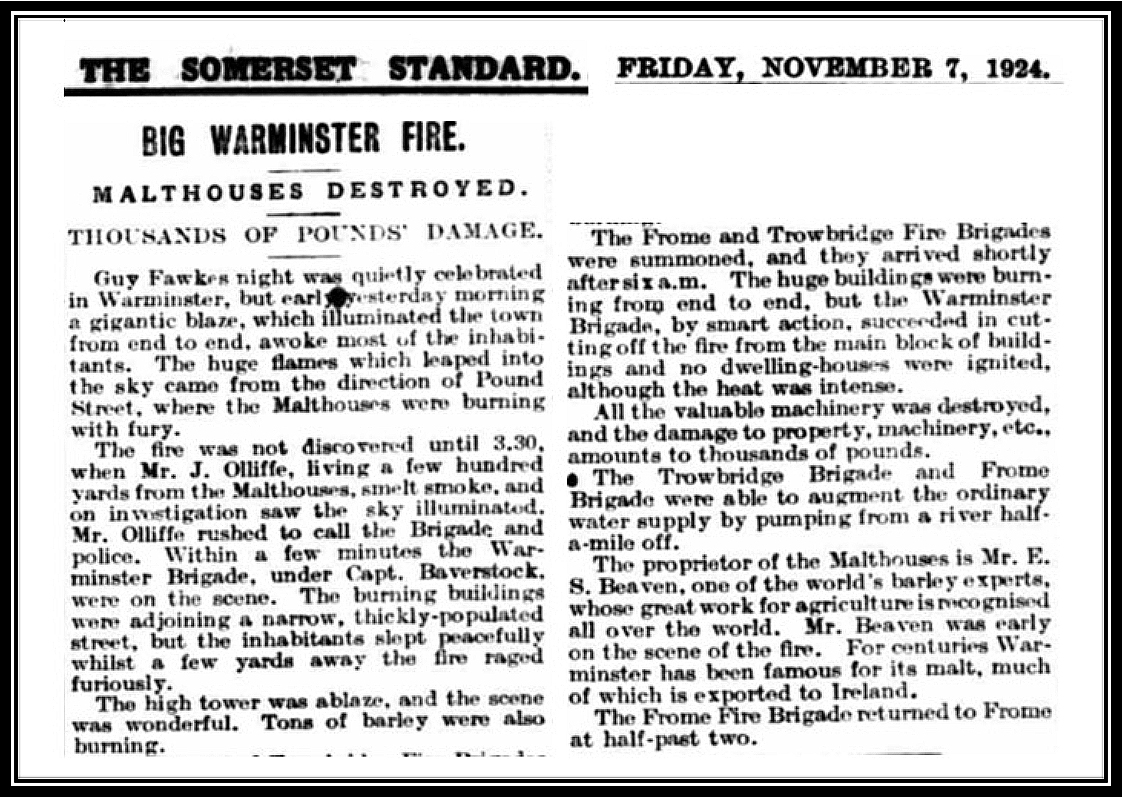
On this day, 99 years ago, Warminster Maltings suffered a rather disastrous and costly event!

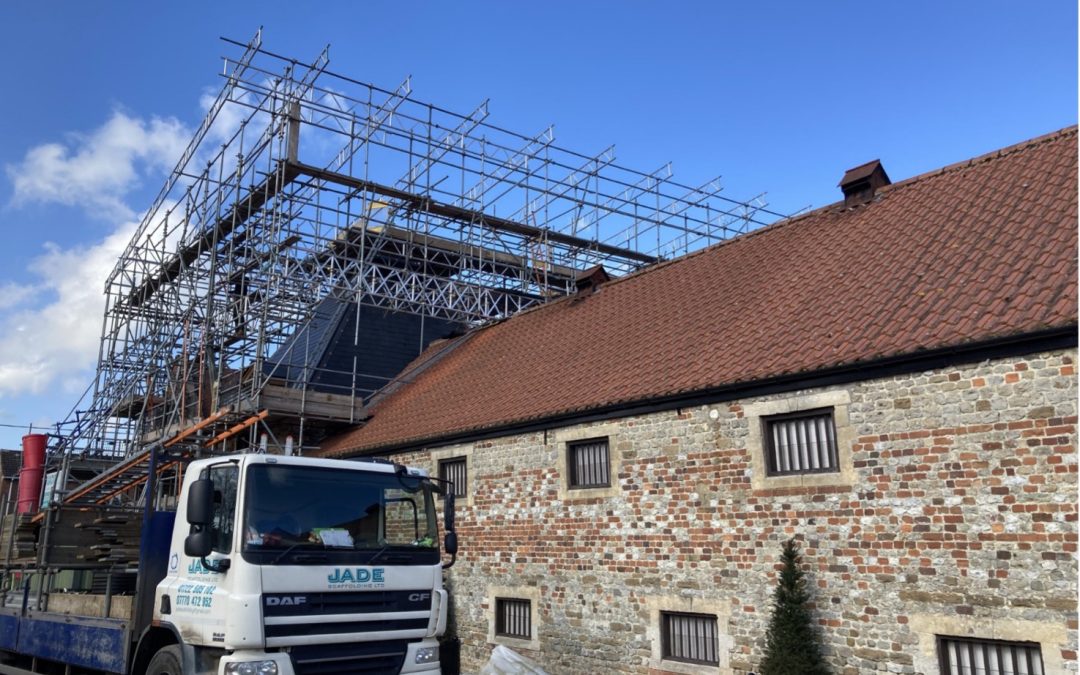
There was a fire which, amongst much other damage, destroyed the ‘pyramid’ style roofs on kilns 3 and 4.
Warminster residents will know this is something we have been working on reinstating – the final phase of our 20+ year restoration project – and there will be more exciting news on this imminently.

But, back to the anniversary of this catastrophic event. It was actually a fairly typical problem suffered by many ‘floor maltings’ at the time. The combination of hot coals, partial timber structures and dry barley and malt grains was always a recipe for disaster.

The ‘Somerset Standard’ reported that “The high tower [the sweater kiln at the other end of the building] was ablaze, and the scene was wonderful”.

I don’t believe that the then custodian, Dr. Beaven, would have agreed it was “wonderful”, but he was fortunately unfazed, and immediately set about rebuilding his malthouses.

And so here we are, 99 years later, still going strong!

Warminster Maltings - Traditional English Floor Malt

“What Goes Round…”

‘Floor malting’ is a centuries old process. There is a Saxon site under excavation close to the Wash in north-west Norfolk, where they have discovered a whole complex of what appear to be malthouses – the archaeologists visited us to establish that the Saxon remains have the same “footprint” as Warminster Maltings. Less than 200 years ago there would have been a small malthouse in every third countryside parish you travelled through.

But at the beginning of the 20th century, new technology from the Continent crept into the U.K. malting industry. It was described as ‘pneumatic malting’, a fully mechanised, controlled environment process which allowed for both greater volume and less time required for each batch of malt, by effectively forcing the modification of the barley into the malt. This new technology was capable of reducing the price of malt significantly but was initially judged by the brewing industry to produce an inferior product and was soundly rejected!

In the aftermath of World War 2, however, the drive towards the industrialisation of our food and drinks industries moved up a gear, which meant Britain’s largest breweries became far more receptive to the price of malt, than to the superior quality of ‘floor made’! So, by the early 1960’s, large scale ‘pneumatic maltings’ priced much of the ‘floor maltings’ industry out of business. By the end of the 1970’s only a handful of ‘floor maltings’ still remained operational, including Warminster Maltings of course.

Today, craft brewers and distillers are returning to being more discerning about the quality of their malt than just focused on the price, and in doing so, they are returning to recognising ‘floor made’ malt as being a superior product, which, in turn, can markedly enhance their own.

Up in Scotland, there is a small number of iconic distilleries which still operate their own ‘floor maltings’, and there is a brand new small distillery that has just opened on Speyside, Dunphail, which includes its own ‘floor maltings’ modelled on Warminster. Of the former, three of these are owned by the Japanese based Suntory conglomerate, one of the world’s largest producers and distributors of spirit drinks. It seems that Suntory agrees with the view that ‘floor made’ malt is a superior product, to the extent that they are now building two brand new ‘floor maltings’, one each at their Hakusha and Yamasaki distilleries in Japan.

From my point of view, this is an extraordinary turn of events. Ever since 2001, when I undertook the task of keeping Warminster Maltings going, I was much derided for trying to prolong a “sunset” industry and have constantly been challenged over the extra cost of ‘floor made’ malt. Now, it seems, both brewers, and distillers, want to return to the very natural process that engineering and scientific intervention have tried, but struggled, to truly replicate.

It seems the old saying rings true, “What goes round, comes round”!

The Barley Tree

Different barley varieties have existed forever. Originally, many were named after the place in which they were discovered, often spotted as a small group of plants growing in the wild. These selections became known as “landrace” varieties, propagated by the farmers who found them. But these varieties were unstable in as much as they would not easily travel. They belonged where they were found, and when a particular variety was found to be especially good, it took very many years for farmers to adapt them to the climate and topography of a different region.

Then along came our very own Dr. Beaven, at Warminster, who practiced barley breeding, by crossing many different “landrace” varieties, until, in 1905, he created the very first “genetically true” variety of barley in the world, our famous Plumage Archer. This barley was stable, and so it would travel. From then on barley breeders worldwide took over the selection of new varieties, and the rest is history, as they say.

Except, “the rest” has become a quest driven more by the agronomic virtues of each new variety, than the quality traits demanded by consumption. In the process, the flavour of individual barley varieties seems to have been sacrificed on the altar of economic performance. So, we are now attaching a level of importance to a secondary group of barley varieties which follow directly from the original “landrace” varieties, which we are now labelling “heritage varieties”. These are the varieties that followed on from Dr. Beaven’s work and were bred in the first half of the 20th century. What is important about them is they retained distinctive flavours because their conception was guided by barley breeders more focused on consumption than production.

So, because you could say it was us at Warminster who started all this, and, courtesy of Maris Otter, have since sought to perpetuate matters (Robin Appel Ltd owns the Production and Marketing Rights to Maris Otter), we have produced a ‘Barley Tree’, entitled “The Evolution of U.K. Heritage Barleys”. We have yet to produce it as a Poster, but we can if demand exists.

Demand for the actual barleys, on the other hand, is very real indeed, with an extraordinary level of interest from the distilling sector in particular. You could say another example of “what goes round, comes round”!

Robin Appel

Edition 48: Friends of Warminster Maltings

Edition 48: Friends of Warminster Maltings

We’re On The Telly, Again!

“A Cotswold Farmshop”, a new series on Channel 4, on Monday nights at 8 o’clock, began screening on Monday August 7th. There are 6 episodes in all, and we appear in the second quarter of the 6th and final instalment, and so, (provided the August Bank Holiday has not interfered with the schedule), we should feature on the evening of Monday 11th September, at 8 o’clock. Or you can watch us on 4’s catch up

The programme seeks to promote the superior quality of traditional and artisan foods and beverages, which, in the case of this particular outlet, are mostly sourced from very local producers just a few miles away from the Service Centre. Our contribution is the supply of malt to Craft Breweries in the immediate area, including Stroud Brewery, which makes its appearance immediately after us.

I have long lost count of the number of times acquaintances have walked up to me and said, “I saw you on the television the other night”. This is not because I, or Warminster Maltings, have become ‘TV personalities’, not at all! It is all about a single episode of “Great British Railway Journeys” hosted by Michael Portillo, that we filmed with him many moons ago. It seems it gets repeated and repeated, albeit on what I refer to as the ancillary TV Channels. We have done others: “Countryfile” with Adam Henson, “Antiques Road Trip” and “Move to the Countryside”, but none of these get to re-emerge like “…Railway Journeys”.

Warminster Maltings - Traditional English Floor Malt

Gloucester Service Station

I do not have a handle on the viewers ratings for “A Cotswold Farmshop”, but based on its predecessor series, it will get repeated. Either way, one thing is for certain, visitor numbers to this M5 Motorway Service Centre, which is already 4 million persons per annum, will certainly increase! But what I would really like to see come out if this is some remodelling of some of the other Service Centres we have to put up with. Has anyone from Moto Services been looking?

 Heritage Open Days 2023

We are always keen to support this event, and for this year we have offered x2 Maltings Tours on Friday 15th September, one in the morning at 11.00am, and one in the afternoon at 2.00pm. Both were very quickly fully booked.

It is very flattering to discover we attract so much interest. We are repeatedly told that consumer interest in the source and provenance of their food and drink is now ramping up to a whole new level, and so it should. I have just finished reading Henry Dimbleby’s very recent publication “Ravenous”, an alarming expose of ‘ultra processed food’, but also a brilliant prescription for what we can do about making our diet a whole lot healthier. We will talk about this on the tours and demonstrate Warminster Maltings proactive contribution.

Teas in the Garden Cancellation, September 13th.

It is with much regret, our last Tea Party in the garden, on 13th September, has to be cancelled, because Pat Whitty, who masterminds these events, is not very well.

We have had a good run, 27 guests in June, and 38 in August. July was down to 12 only, thanks to a depressing weather forecast that morning which did not actually transpire in the afternoon. We will of course hope to renew this hospitality again, next year, because we also very much enjoy these events, meeting all those that come along, and sharing news of developments at the Maltings.

It is all about doing what we can to share our presence in the community. We are a particularly significant part of Warminster’s history, which continues almost unchanged. It is unusual.

Recruitment

We are very lucky at the Maltings to have a very low turnover of staff. Most live locally, some even walk to work. However, out of a team of 16, we do have one or two places out in the Maltings that fall vacant from time to time. This is for a number of reasons: age, of course; moving home; recurring problems from injury incurred elsewhere, mostly sport.

Replacement, courtesy of a simple job advert, is now proving a little more difficult than it used to be.

So, we recognise we need to be a bit more proactive in encouraging apprenticeships, and what is more, apprenticeships with a clear indication of advancement, and greater responsibility.

We like to think we have created a more enlightened approach to running this business and practise a very inclusive style of day to day management, encouraging and driving a policy of continuous engagement across the whole team. All of us must constantly ‘think on our feet’, and so we really do value everyone’s contribution, which is always most helpful.

We also have a formal Advanced Training Scheme for any staff members who wish to take advantage of it. This covers an understanding of the whole process of making malt, from barley procurement right through to meeting customer demand for the wide range of malts we sell. The spin off from this has been that one of our maltsters is now capable of donning a white coat and conducting all our quality control procedures within our laboratory, and another has become an accomplished ‘Maltings Tour’ guide.

So, my message is, we would very much welcome enquiries from students set to leave school in the next 12 months. We know we can offer a rewarding career to anyone who would like to take up a very traditional craft. We have some very exciting plans ahead of us, and space for sharing these with anyone who thinks they might be interested.

Please get in touch with us at 39, Pound Street, Tel: 01985 212014.

Harvest Review 

The weather in July and August has not been the most perfect for bringing in the corn, but as always, farmers have found a way. With all the barley across the south of England now safely gathered in, we can offer an early assessment. 

Yields of barley have not broken any records this year, and if the National Malting Barley Competition – something of a beauty contest – was still an annual event (it was disbanded 20 years ago, or more), I have seen very little that would attract the judge’s eye. But the crop is sound.

We have bold, if not particularly beautiful, grain, +/-70kgs/hl; nitrogen content of 1.5-1.6%, and 100% germination capacity.

So, as long as germination remains robust, we would anticipate good extracts and spirit yield from all our barleys – Laureate (Spring), Maris Otter and our Plumage Archer. When we switch over to ‘new crop’, probably not until late October/early November, we will continue to major on these 3 varieties only, simply because there is no good reason not to. Following a tricky harvest, that is not the time to experiment! Besides, the headwinds in the brewing industry remain unabated. So, for the time being, we feel if we can bring some certainty to the party, then it is incumbent on us to do so. I am sure our customers will appreciate this.

Robin Appel