Edition 57: Friends of Warminster Maltings

Edition 57: Friends of Warminster Maltings

Press release

In mid-February we issued a new pamphlet showing off our maltings, photographed from the air by a drone mounted camera. This was both transmitted electronically and sent out as hard copies. We are attempting to address a very wide audience, drawing their attention to the completion of 24 years of very hard and highly skilled work, both repairing and restoring our malthouses.

All this work has been carried out to not only enhance the resilience of the fabric of the buildings, but to also incorporate, where necessary, modern infrastructure for making malt in the 21st century. However, throughout, the priority has always been to protect the integrity of the external architecture of our Grade 2* Listed malthouses. Today, they should look almost the same as the complex that William Morgan built back in 1855, with x3 (out of x4) of its original pyramid style kiln roofs dominating the western elevation.

So, after 24 years, you will not be surprised we want to celebrate this achievement, which we will probably do all year. Already, we are finalising the highlight, which will be a formal ‘unveiling ceremony’, on Wednesday evening, June 11th. This will be performed by Miles Jenner, MD of Harveys Brewery in Lewes, and President of the Brewery History Society. This evening party will include mini-tours of the malt floors, a chance to view our new museum, and, “for one night only” our attempt to portray the Warminster Maltings Story, our very own performance, in words and music, by a whole swathe of local artistes and musicians. A hog-roast will be served all evening, and, of course, there will be an extensive choice of beers.

This has to be an “Invitation Only” event (we are not selling tickets), first of all targeted at our customers, also our suppliers, and all those who have helped us along the way. Initially, invitations have to be limited on account of our limited space. They will go out in April, and if you receive one, and you would like to attend, you are asked to ‘RSVP’, and we recommend you reply sooner rather than later.

If you do not receive one, but you would like to come, you can apply to the office for an invitation, Email: lisa.conduit@warminster-malt.co.uk and we will try and accommodate you. We apologise we have to word it this way, because, at this stage, we have no idea of how many on our invitation list will respond. But we do have a very good idea of just how many people we can fit in.

June 11th is not just “any excuse for a party”, but very much all about maintaining a high profile for our business. The brewing industry currently faces serious headwinds, and even the distilling industry is not selling as much whisky today as it was 2 or 3 years ago. So there is absolutely no room for any complacency at Warminster Maltings – we have to be continually transmitting our message, and finding new ways to do it. After all, we always need new enquiries, it is key to ensuring we remain constantly busy.

A View on the Future
On the subject of ‘new enquiries’, we hope we will continue to attract them. According to Jeffrey M Pilcher, Professor of History and Food Studies at the University of Toronto, in his new book “Hopped Up”, the future of Craft Brewing “depends on maintaining a moral high ground through associations with desirable qualities such as local, artisanal, communal, sustainable and nostalgic beers”!

At Warminster Maltings, we would like to think we do provide some of this. And, we are always more than happy to share our contribution with our customers, in whatever form they request. In the last few weeks, we have entertained two separate customers with their film crews, compiling footage for websites and social media platforms. We are open to doing more. As my father used to say to me, when I was young:

He who whispers down a well,
of the goods he has to sell;
never makes as many dollars,
as he who climbs a tree, and hollas!

Vive La France!

A headline which caught my eye since the last newsletter: “French drinking more beer than wine!”

According to this report, between the years 2019 and 2023, beer consumption exceeded wine by 5%. It seems they are now knocking back 26 litres/household/annum, up from 24 litres.

There was no real analysis offered, but in a country where there are far less Craft Breweries per capita compared to the UK – at the most no more than a third – this is perhaps a remarkable turnaround. At Warminster we do not have any further insight on this, we lost most of our French customers on the back of Brexit. But a simple explanation could be that the French attitude to beer is not dissimilar to their attitude to food. They take pride in only producing the best. After all, they do have a long history of making beer. Archeologists have discovered the remains of Roman Breweries in Brittany, so wine making and brewing have almost certainly grown up side-by-side. That the more discerning palate of the French is shifting in favour of beer, is most encouraging.

MaltingsFest 2025!

Thursday 10th – Saturday 12th April
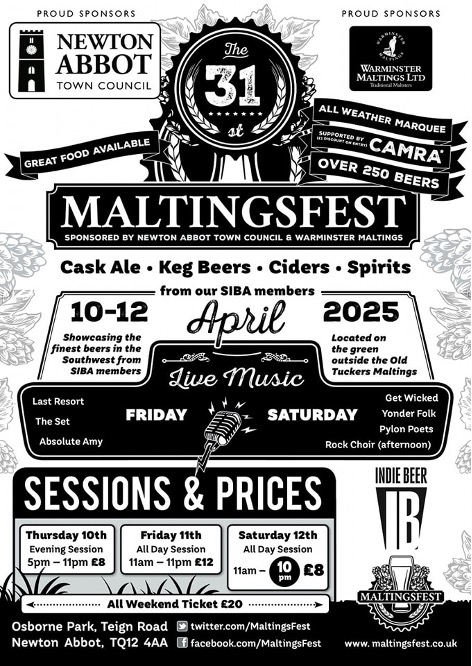
Next month marks the 31st annual MaltingsFest, held once again at Osborne Park, Newton Abbot, Devon – a celebration of the fantastic beers crafted across the South West.

It’s a brilliant opportunity for brewers, including many of our valued Warminster Maltings customers, to showcase their brews, and perhaps even take home an award or two!

Unfortunately, we’re unable to attend this year and have taken a step back from our usual role as lead sponsors (due to our own exciting celebrations on the horizon), but we highly recommend getting along to it if you can.

Whether you join for one session or soak up the atmosphere across the whole festival, we’re sure you’ll be in for a treat—great beers, great company, and a fantastic experience!


Robin Appel & Lisa Conduit

Edition 56: Friends of Warminster Maltings

Edition 56: Friends of Warminster Maltings

Celebrations

2025 is set to be an extraordinary year at Warminster Maltings.

We celebrate 170 years in the malt making business!!

And that’s not all… after 24 years, we celebrate the completion of our repair and restoration work. A long project indeed but well worth it to bring this marvellous building back to its former glory, and to preserve the traditional craft of floor-malting.

It really is rather special, you know.

We will honour these milestones, but we do not wish to give away too much at this point. We’re plotting and planning a very special event, and do not want to jinx it but suffice to say, we will be throwing a party like no other!

Keep your eyes peeled for further updates but for now, save the date..

Floor-midable!

We have said it before, but when a third party goes into raptures about ‘floor malt’ delivering enhanced flavour, you will forgive us for repeating their proclamations. I am, this time, talking about a message from the whisky sector rather than the brewing one, but does that matter? ‘Floor malt’ has more flavour than ‘commercial malt’, so says a report in Whisky magazine (Issue 202), published last September. ‘Floor malt’ delivers “…added aromatic complexity and mouthfeel” and “can significantly increase the quality of single malt whiskies”.

This report does refer to distilleries in Scotland which have their own ‘floor maltings’, so you might conclude “they would say that, wouldn’t they?” Except, the huge investment that is made in distilling whisky is not one to be trifled with. Besides, the stories of the water, the wood, the peat, and the height above sea level can mostly be more than enough to distinguish one ‘single malt’ from another, without having to resort to the malt. So I think we should believe them!

At Warminster, we have always been convinced our malts have more flavour. We put it down to the more natural “modification’ of the barley into malt, the grain responding to the ambient temperatures which in turn reflect the time and seasons of the year – receding versus expanding day length. The barley grain is sensitive to all this, viz. dormancy! Added to this are the natural yeasts that inhabit our 170 year old malthouses. They too, I am reliably informed, will add yet another element of flavour.

So for all you brewers who prefer ‘malt forward’ beers, or distillers who are looking for something a little more complex in flavour, you need to look beyond ‘commercial malt’, it is ‘floor malt’ you should focus on. More than that, explore Heritage Varieties as well, and I include Maris Otter as well as our very own Plumage Archer. This year, Maris Otter barley (1965) celebrates 60 years of continuous production, at the same time as Plumage Archer barley (1905) celebrates its 120th birthday. So, there you are, in 2025, you have even more stories to add to the magic of the brew!


Indie Beer!

We must welcome SIBA’s new marketing initiative for Craft Brewers, “Indie Beer” or “IB” as it will hopefully appear on pump clips, bottle tops and containers. The timing is probably particularly good, with the recent announcement of forthcoming closures of some of Britain’s most iconic breweries – Banks, Marstons et al – but retention of the labels, all coming out of the same pipe at a mega beer factory far away.

The global brands glaringly cynical approach to the production of beer should surely make us all even more wary. Scientists have already inflicted enormous damage to much of our diet consumed out of convenient and economic constraint, with the evidence of NHS statistics screaming “When is someone going to do something about this?”

So, if we cannot keep new technology away from our beer, let’s make sure that beer keeps well away from us!

A couple of years ago, we were involved in the recreation of a Tudor Beer by Trinity College, Dublin. We made the malt. Based on a recipe retrieved from Dublin Castle, the beer was one that, in the day, had been consumed at what might be seen as a prodigious rate. We are talking about individual consumption of up to 15 pints per day. But we are talking about a long day, consumption beginning early in the morning, and continuing until late in the evening. And, we are talking about a working day, a long working day. The point is the beer was seen as “liquid bread”!

At the outset of this experiment, it was thought the beer that Trinity College set out to recreate would be of a low alcohol content, no more than 2.0% ABV. In reality, it was in excess of 5.0% ABV! But there is no record of men becoming drunk, because consumption was spread over 14 to 16 hours, and the “liquid bread” was very quickly burned up.

I relay this story, because I think it serves to describe the true worth of a good, traditionally brewed, pint of beer. It is food, and drink, and vastly better for you than anything interfered with by scientists. So long live “Indie Beer”, and our Craft Brewers upon whom we can now almost only depend, for a decent pint to truly nourish us.

Happy New Year!

We close the first newsletter of 2025 by thanking you all for your support throughout the past year and wishing everyone all the very best for the year ahead.

We hope it is a happy, healthy and prosperous year for all.

Robin Appel & Lisa Conduit

Edition 55: Friends of Warminster Maltings

Edition 55: Friends of Warminster Maltings

Harvest Report.

On Friday, October 25th, I was privileged to be invited to address a SIBA South West meeting, held at the Ring O’ Bells pub in Bath, and deliver a Barley Harvest Review. After all the rain we have had over the last 12 months, I suspect my audience was a little concerned. I hope I put their minds at rest.

Harvest 2024 has been hailed as the worst harvest since the 1980’s. (This probably relates to 1984, when much of the English crop was completely flattened to the ground by exceptional storms that crossed the country a couple of weeks ahead of harvest). This year’s poor performance is all about reduced yields, and an overall serious shortfall of crop, but mostly wheat.

Again, we can blame the rain, but not an individual storm, instead, continuous, almost ceaseless, precipitations.

As far as I am concerned, it started raining last October (2023), and has not stopped since, and the guys at the Met Office are now repeating as much. So, not surprisingly, plantings of Winter Barley – sown end of Sept/early Oct. – were reduced. This has not really had any major detrimental impact on the brewing industry because at the same time we saw a ‘correction’ to the demand for Maris Otter, probably the most important of the Winter Barley varieties, due to a downturn in demand for ‘Otter malt in North America.

Instead, the figures suggest that any Winter Barley not planted, was turned over to Spring Barley: Winter Barley production across England is down 700,000 tonnes in 2024 (compared to 2023),

Spring Barley up 900,000 tonnes. But this Spring outcome was a close run thing! The perfect ‘window’ for planting Spring Barley in the south of England is February 15th to March 15th. But this was never possible this year, with the persistent rainfall. Instead, for many, Spring sowing never really got going until the end of April. Luckily, May returned to more rain, and the barley crops established well despite being more than a month behind schedule. The month of June was also kind to the barley crop, short periods of sunshine (interspersed with more rain), but no heatwaves to stunt leaf and stem development.

The Winter Barleys made it to harvest almost on schedule, mid-July, but the early samples were not as bold as expected, due to lack of sun. But later harvested crops improved, to being very acceptable. Grain nitrogen content was a ‘stand out’ feature, being at the lower end of the preferred range (1.40 – 1.65%), but with much of the Winter variety Craft being even lower still, rendering it unfit for brewing.

The Spring Barleys remained lucky, the continued unsettled weather allowing for an extended growing season stretching the harvest date to the third week of August. All the wet has probably contributed to the boldness of the grain, and, again, low grain nitrogen, albeit mostly well within the preferred range (1.40 – 1.65%).

The total English barley crop in 2024 is estimated to be a little short of 5 million tonnes, Scotland has yet to be confirmed. The U.K. malting industry as a whole requires 2 million tonnes, and that, of course, includes the Scottish crop. So there is no real shortage of barley, the malting market just has to pick its way through the available crop, seeking out bold samples of the right variety, with plenty of germinative capacity, and germinative energy.

As far as Warminster Maltings customers are concerned, I was pleased to report that already “All is safely gathered in”!

More Dialogue with Barley

I took advantage of my ‘platform’ in front of a SIBA audience to briefly raise two more subjects that I felt should be of concern to brewers. I am talking about the separate impacts of “Regenerative Agriculture” and “Climate Change” on the barley crop, going forward. 

Firstly, “Regenerative Agriculture”, a broad term which covers a multiplicity of ways cereal growers are trying to make their crop production more sustainable. Farmers have already been experimenting with this for 4-5 years or more, so that it is now possible for analysts to plot indicative trends. One of these is that yields of cereal crops are going down. Not dramatically, and of course, as soil fertility improves, this may level out, or even climb again. But, for the meantime, if yields decrease, prices need to increase! Brewers need to be aware of that.

My second point concerned “Climate Change”. 10-15 years ago, we were led to believe that, across the south of England, at least, this probably meant more of a Mediterranean climate. As a result, farmers started planting vineyards everywhere, and even famous French brands joined in, buying up Sussex farmland to establish their own domains. But a very recent long range weather forecast, commissioned by these winegrowers, has presented an outlook for the next 10 years, that is far from what they wanted. It has suggested that the weather pattern of 2024, of incessant rainfall, is a far more likely outlook than the sunnier climes of before. So, what would be the impact of this on cereal production?

My contention is it would not be good for wheat growing, particularly for the production of high protein wheat for bread making. On the other hand, barley production, which prefers a ‘maritime climate’, this would be far more likely to endure. In fact, it might even mean that for farmers, barley becomes the first cereal crop of choice (instead of wheat), like it used to be 60 years ago.

That could be good news for brewers!

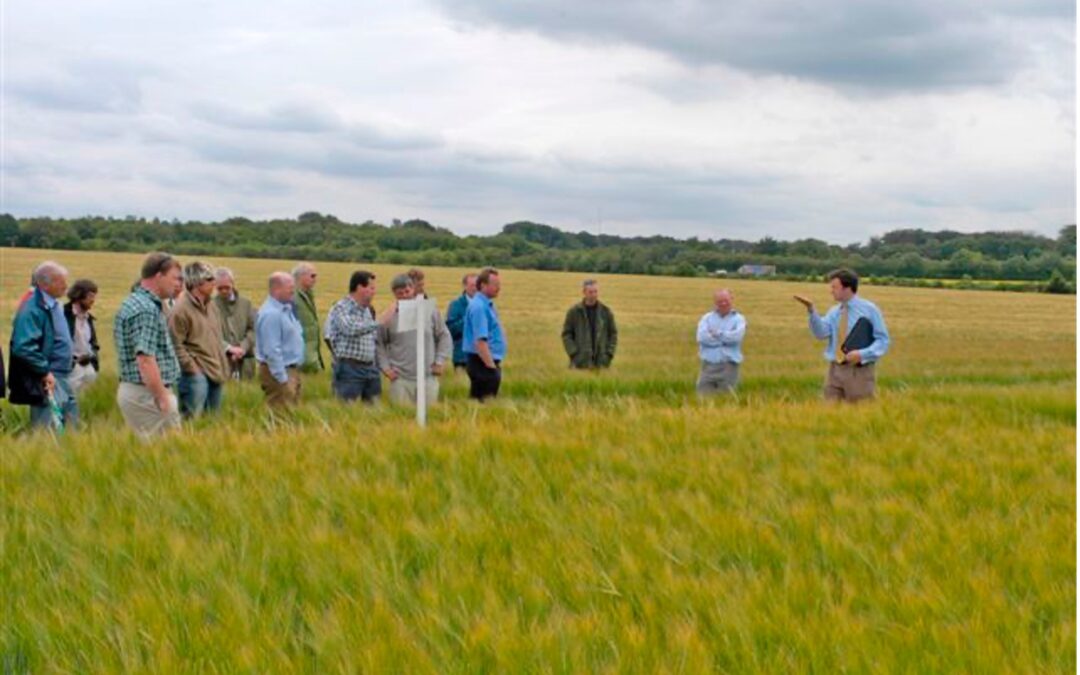
However, I went on to insist that none of this should be taken for granted. Instead, with all this potential change, I suggested now was the time for brewers to get a lot more engaged with barley growers to protect their most valuable resource. I went on to offer my SIBA audience “A Barley Walk” next summer, when we can arrange an array of Winter and Spring barleys, on adjacent farms, for inspection and discussion. We might even try and engage barley breeders, along with the farmer growers. This, I feel, could create a most valuable dialogue for brewers going forward, which my audience appeared to be very enthusiastic to support. We will have to see what we can do!

A Charitable Contribution

Our ‘Teas in the Garden’ have long been popular events here at the Maltings but this year we decided that we’d like to do a bit more with them and so chose to donate all the funds raised to the Warminster Alzheimer’s Support Day Club.

We also held a couple of tours of the Maltings where the ‘begging bowl’ was out, and we are delighted to have raised a grand total of £1255.

Robin Appel, Pat Whitty, Rachel Fear and Judy Nash

It was fitting that Pat Whitty and Judy Nash who are the curators (and, crucially, the star bakers for the teas) met with Rachel Fear, the Community Fundraising Manager for Alzehimer’s Support, to present the money.

Thank you to everyone who came along for their generosity. We intend to repeat this next year.

Warminster Town aka The Malt-Men!

Warminster Maltings are long standing sponsors of Warminster Town Football Club, and it’s a relationship we are delighted to continue with. We especially enjoy the moniker “The Malt-Men”.

The first team had a promising start with a win and three draws from the first five games. Since then, the journey has been both up and down! There have been some strong performances at home but away games have appeared more challenging, with only one point gained on the road.

Having been hit with some injuries has hardly helped but many of the games have been close.

The reserves, after a shaky beginning, are now finding their stride. The young team has moved to mid-table, playing some impressive football along the way. And while the veterans had a slower start, they celebrated their first win against Radstock last week and are currently positioned just below mid-table.

Here’s hoping it’s an upward trajectory for all from now on.

Robin Appel
& Lisa Conduit